 Click here to open LT Reconstruction video.
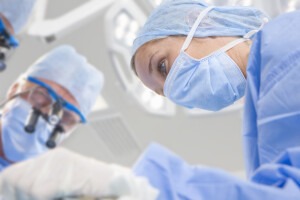
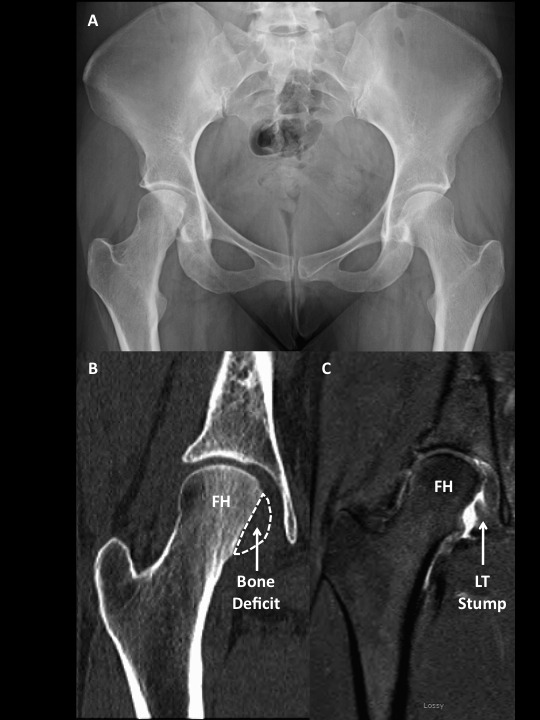
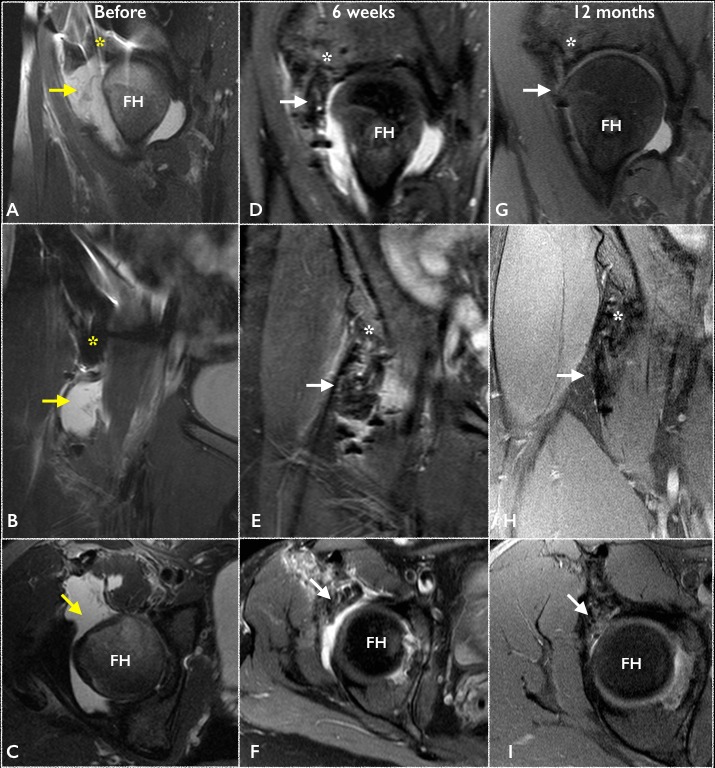
This video demonstrates treatment of recurrent hip instability in the setting of femoral head bone loss and deficient ligamentum teres (LT). This is an extremely unique and difficult case as there is a lack of bony support in front of the hip to keep the joint stable. Left untreated, the hip is at risk for recurrent dislocations and cartilage injury. The treatment is a minimally invasive outpatient procedure called hip arthroscopy, which is done through two small incisions allowing for an accelerated recovery. As seen in the video, a tissue graft is used to reconstruct the ligamentum teres (LT) to restore stability. Preoperative x-rays and CT scans demonstrate the degree of bony deficiency:
Often, the underlying bony abnormality must also be addressed to restore hip stability. This involves more complex realignment procedures including periacetabular osteotomy (PAO) and/or derotational femoral osteotomy (DFO). Through this holistic approach combining open and arthroscopic treatments, patients can enjoy an active and pain-free lifestyle for many years to come!
Dr. Tigran Garabekyan is a board certified orthopedic surgeon specializing in hip preservation. To learn more about Southern California Hip Institute or to schedule a consultation, click here to contact us. Serving patients in Encino, Sherman Oaks, Van Nuys, North Hollywood, Burbank, Glendale, West Hollywood, Century City, Beverly Hills, Santa Monica, Los Angeles, and other neighboring cities in the greater Los Angeles area.
 Unfortunately, most people living in today’s world want everything to happen faster and have little patience for letting their bodies acclimate to the sudden shifts in their lifestyle. As a result, they use anti-inflammatory medication to reduce pain and swelling, allowing them to continue the high intensity activities that cause re-injury and progressive damage to their muscles, tendons, and joints. This is not a good use of NSAIDs and can result in the accumulation of significant damage requiring more invasive treatment.
 When muscles and tendons are placed under a gradual and sustained stretch (no bouncies), several physiological phenomena occur that serve to ready the muscle unit for action. Through the activation of β-receptors, arteries providing blood flow to the muscles dilate causing a subtle engorgement, which provides ready oxygen for aerobic consumption. In addition, nerve fibers conveying inhibitory signals to relax the muscle (as a part of a protective mechanism to prevent muscle injury from over-stretching) become conditioned and reduce their inhibitory effect. This enables peak muscle performance without reflexive inhibition at the extremes of stretch. The muscle and tendon unit is now ready to fire on all cylinders and through the full range of motion, giving you peak performance.
 Given the increasing popularity of CrossFit, High Intensity Interval Training (HIIT), and Spin Classes, we’d like to take a moment to reflect on the pros and cons of each from an orthopedic perspective.